
RightRisk News
Latest News
Recent Virtual Fence posts published through RightRisk News.
Virtual Fence updates
Recent posts
These posts are published on RightRisk News and displayed here automatically. The original RightRisk News post remains the source version.
The Six Risk Controls | RR Virtual Fence
#RightRisk #RiskInAg #AgRiskMgt
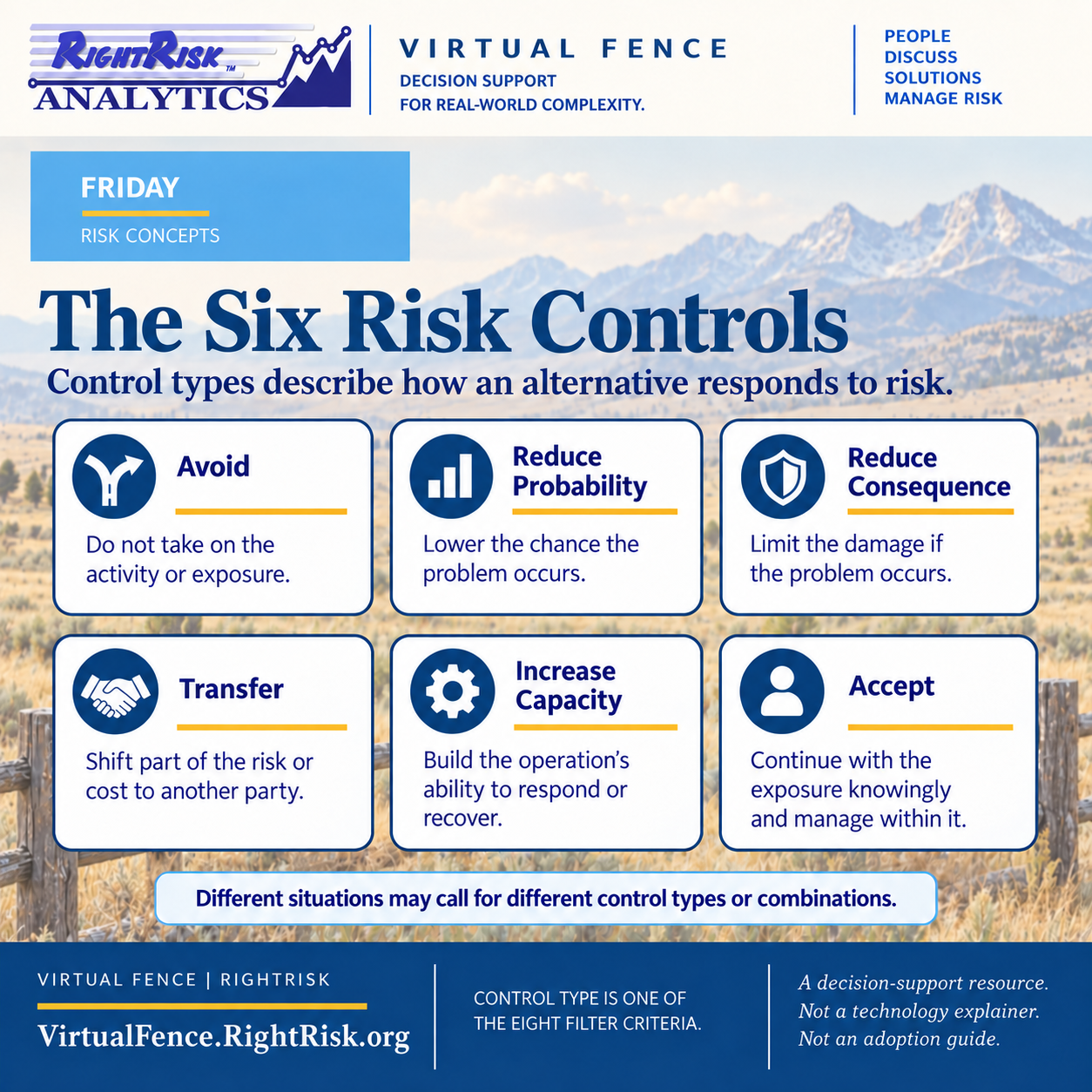
- The Six Risk Controls
To read more see RightRisk.org/News > Virtual Fence
CLICK HERE
to view the post PDF
SIX RISK CONTROLS describe what an alternative is doing from a risk management standpoint: avoid, reduce probability, reduce consequence, transfer, increase capacity to bear, and accept. Two alternatives that look similar on cost can be doing entirely different risk work. Accepting a risk and proceeding without additional control is one of the six rather than an absence of management. Naming the control makes the comparison between alternatives legible …
The Multi-Temporal Risk Analyzer | RR Virtual Fence
#RightRisk #RiskInAg #AgRiskMgt
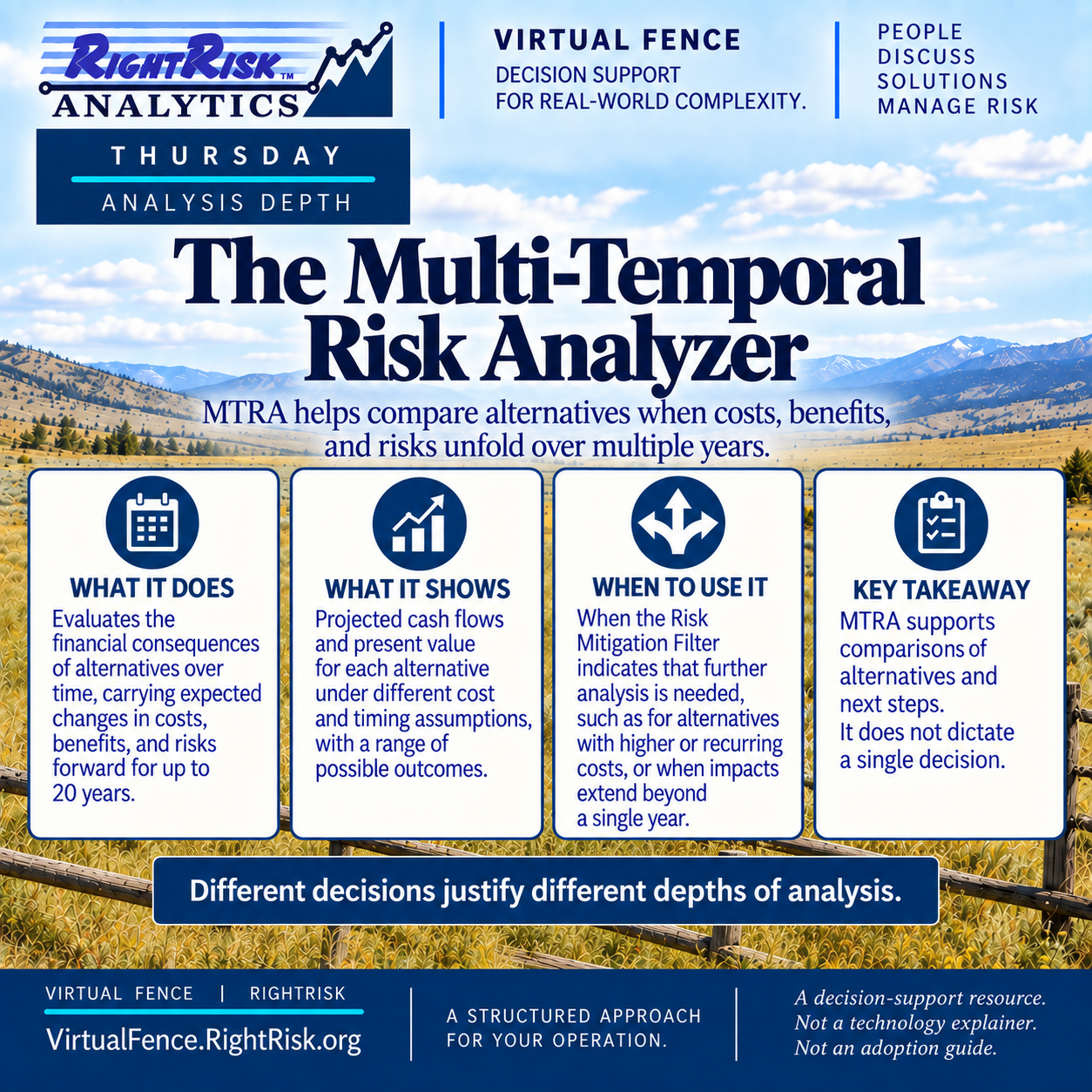
- The Multi-Temporal Risk Analyzer
To read more see RightRisk.org/News > Virtual Fence
CLICK HERE
to view the post PDF
THE MULTI-TEMPORAL RISK ANALYZER (MTRA) follows a partial budget framework and carries expected changes forward for up to twenty years. It fits decisions where the alternatives have different cost structures over time, such as a one-time construction cost set against recurring equipment, service, and replacement cycles. Results are reported on both a cash basis and a present value basis, showing a range of possible outcomes rather than a single number. A mixed result is still information, because it shows which few assumptions the decision actually turns on …
Rough Country, High Costs, Hard Choices | RR Virtual Fence
#RightRisk #RiskInAg #AgRiskMgt
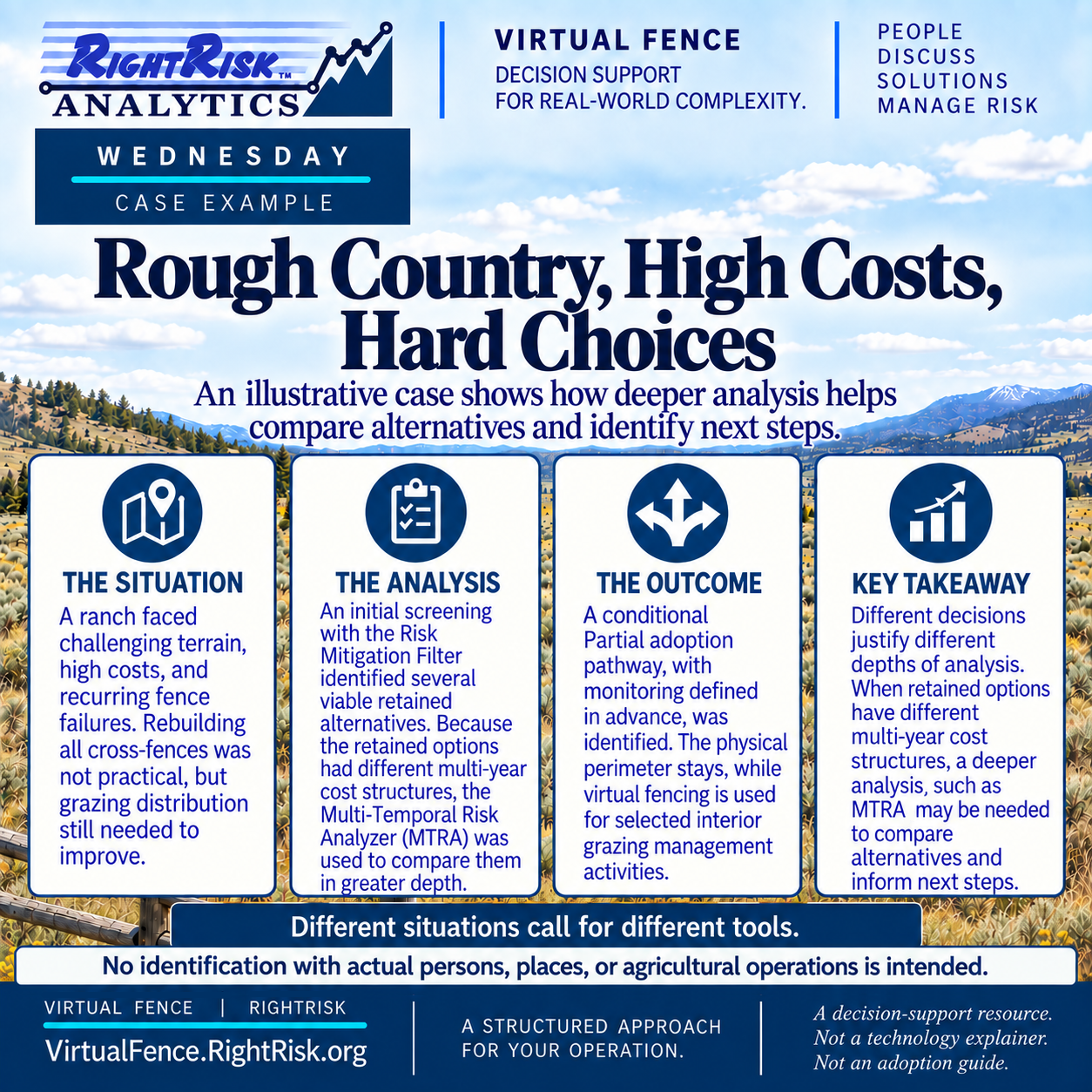
- Rough Country, High Costs, Hard Choices
To read more see RightRisk.org/News > Virtual Fence
CLICK HERE
to view the post PDF
THE CARVER RANCH compared rebuilding an interior cross-fence against a hybrid arrangement keeping the physical perimeter while using virtual fencing for selected interior jobs. Two alternatives carried a multi-year cost structure and a high failure consequence, which routed them out of screening and into longer-horizon analysis. The ranch recorded a conditional Partial adoption pathway with monitoring defined in advance rather than an immediate full commitment …
What the Ratings Ask You to Judge | RR Virtual Fence
#RightRisk #RiskInAg #AgRiskMgt
- What the Ratings Ask You to Judge
To read more see RightRisk.org/News > Virtual Fence
CLICK HERE
to view the post PDF
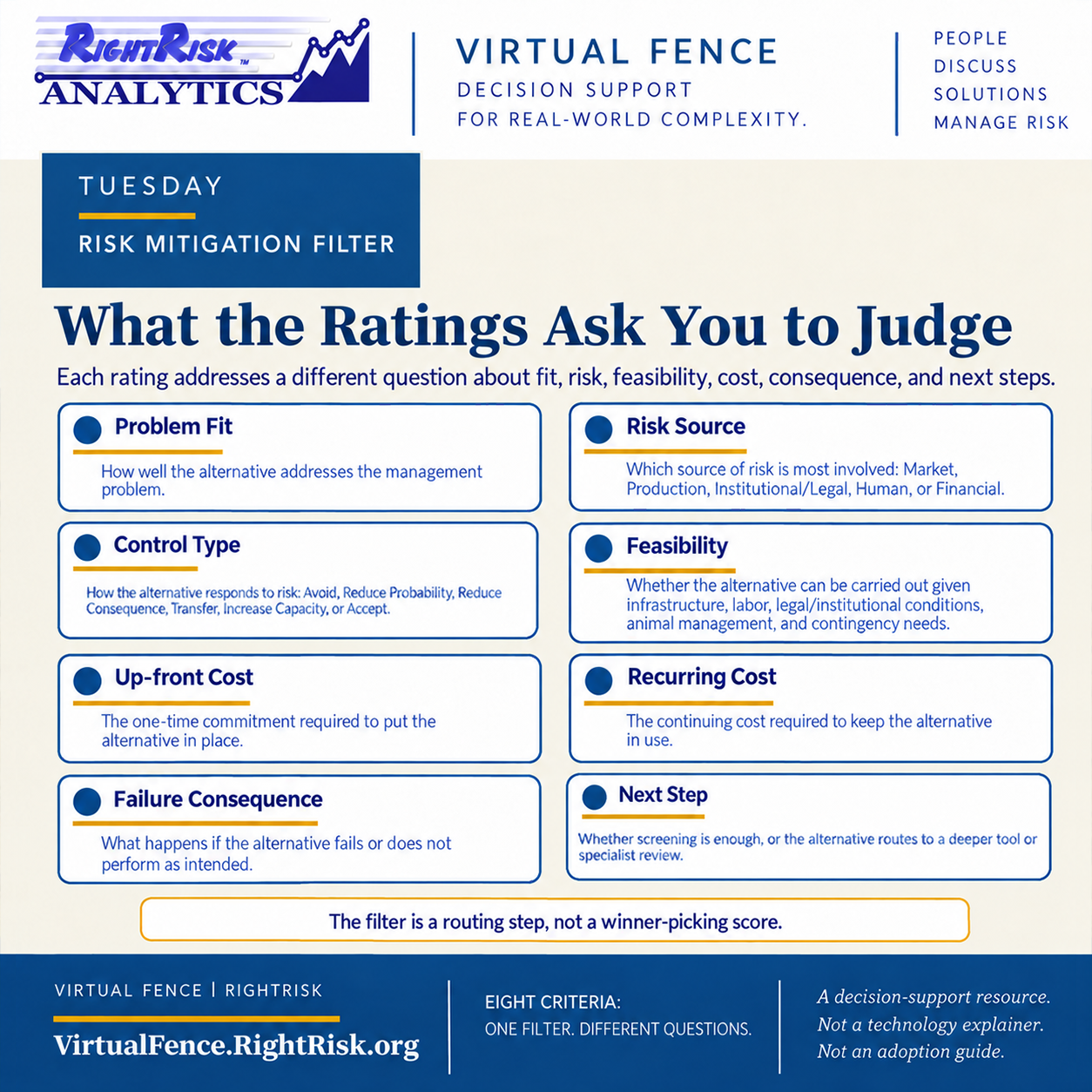
EACH COLUMN on the filter asks for a different judgment. Problem fit asks how directly an
alternative addresses the problem as written, risk source and control type ask what the
alternative is doing in risk terms, and five feasibility entries ask whether infrastructure, labor, legal conditions, animal management, and contingency arrangements are in place. Up-front cost, recurring cost, and failure consequence are rated separately because a low-cost alternative can still carry a serious consequence if it fails. The guide holds the current definitions for each rating …
Where Do I Want to Go? | RR Virtual Fence

#RightRisk #RiskInAg #AgRiskMgt
- Where Do I Want to Go?
To read more see RightRisk.org/News > Virtual Fence
CLICK HERE
to view the post PDF
WHERE DO I WANT to go turns a general concern into a stated management goal with a risk goal beside it. The management goal names the outcome the operation is trying to reach; the risk goal names how much variability and how much consequence the operation is willing to carry to get there. Alternatives are identified at this step, along with the kind of risk control each one represents. The outcome is not chosen here, because comparison comes first …